Master the building blocks of every Korean word. Each syllable is a perfectly organized block — once you understand the pattern, everything clicks.
🧱
3
Block Types
🔊
5
Examples
📝
2
Quiz Questions
⏱
~8
Minutes
1
The Building Blocks
Foundation
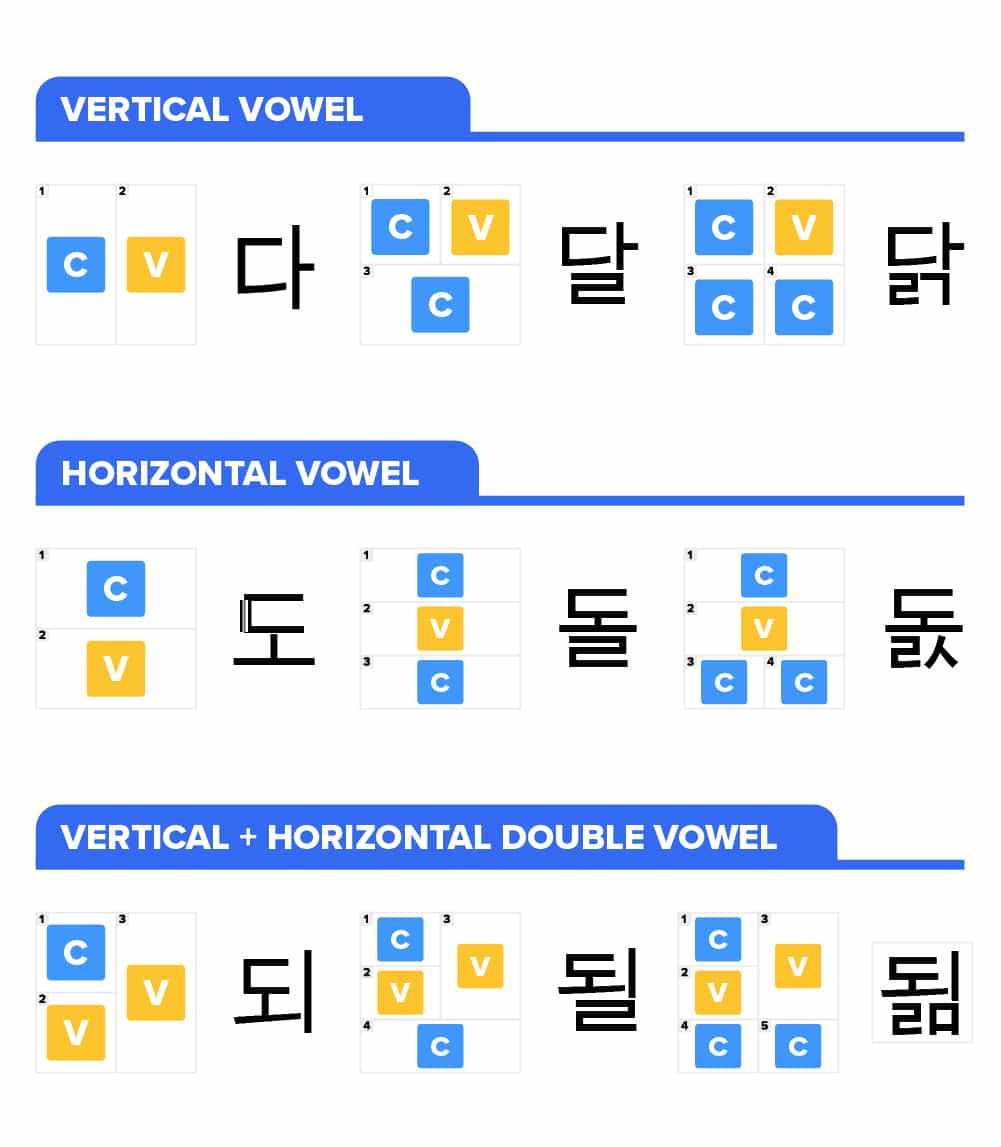
Think of Korean syllables as coordinated blocks. Every block is a tightly organized unit containing consonants and vowels arranged in a precise visual structure — not a line, but a square block.
💡
Golden Rule: You can never have a vowel alone. Every syllable block must begin with a consonant — even if it's the silent placeholder ㅇ. Think of it as a "dummy consonant" that holds the position but makes no sound.
Structure by Letter Count
Korean syllable blocks contain 2, 3, or 4 letters. Tap each example to hear it pronounced.
🔊자2 Letters
🔊남3 Letters
🔊닭4 Letters
2
Position Logic
Structure
Letters follow a strict hierarchy within each block. There are three possible positions, and each has its own rule:
1
Initial Consonant Required
Every block starts with a consonant. If the syllable begins with a vowel sound, use the silent ㅇ as a placeholder.
2
Medial Vowel Required
Always a vowel. Vertical vowels (ㅏ,ㅓ,ㅣ) sit to the right of the consonant. Horizontal vowels (ㅗ,ㅜ,ㅡ) sit below it.
3
Batchim (받침) Optional
The "support" consonant at the bottom of the block. Not all syllables have one — but when present, it affects how the next syllable sounds.
📐 Syllable Block Anatomy
⬛
Position 1
Initial
Consonant Always required
🟨
Position 2
Medial
Vowel Side or bottom
⬜
Position 3
Batchim
Consonant Optional
3
Batchim Pronunciation
Advanced
The support consonant at the bottom often changes its sound. Many different consonants collapse into just 7 basic final sounds when they appear at the end of a syllable block.
⚡
The "Stop Sound" Rule: Consonants like ㄷ, ㅅ, ㅆ, ㅈ, ㅊ, ㅌ, and ㅎ all produce the same stop sound (like a soft "t") when in the batchim position — the sound stops in your mouth without a burst of air.
Batchim Examples — Tap to Hear
꽃🔊
Flower
kkot — stops as /t/
맛🔊
Taste
maht — stops as /t/
4
The Linking Rule
Key Concept
When a batchim is followed by a syllable that begins with the silent ㅇ, the batchim migrates to become the initial consonant of the next syllable. This is called 연음 (Yeon-eum) — the linking rule.
📌 연음 — Linking Rule
If a syllable ends with a batchim AND the next syllable starts with ㅇ (silent), the batchim sound slides forward and is pronounced as the initial consonant of the next syllable.
먹어요→머거요ㄱ links forward · tap to hear 🔊
한국어→한구거ㄱ links forward · tap to hear 🔊
🎯
Assessment Quiz
Test what you've learned · instant feedback
Score0/ 2
1
What is the maximum number of Hangul letters that can fit inside one syllable block?
2
A syllable block must always start with which type of letter?
★
In 꽃, the ㅊ batchim is pronounced as which sound?
★
What is the term for the rule where a batchim moves to the next syllable when followed by ㅇ?